

Once before a court, a defendant is asked to enter their plea.
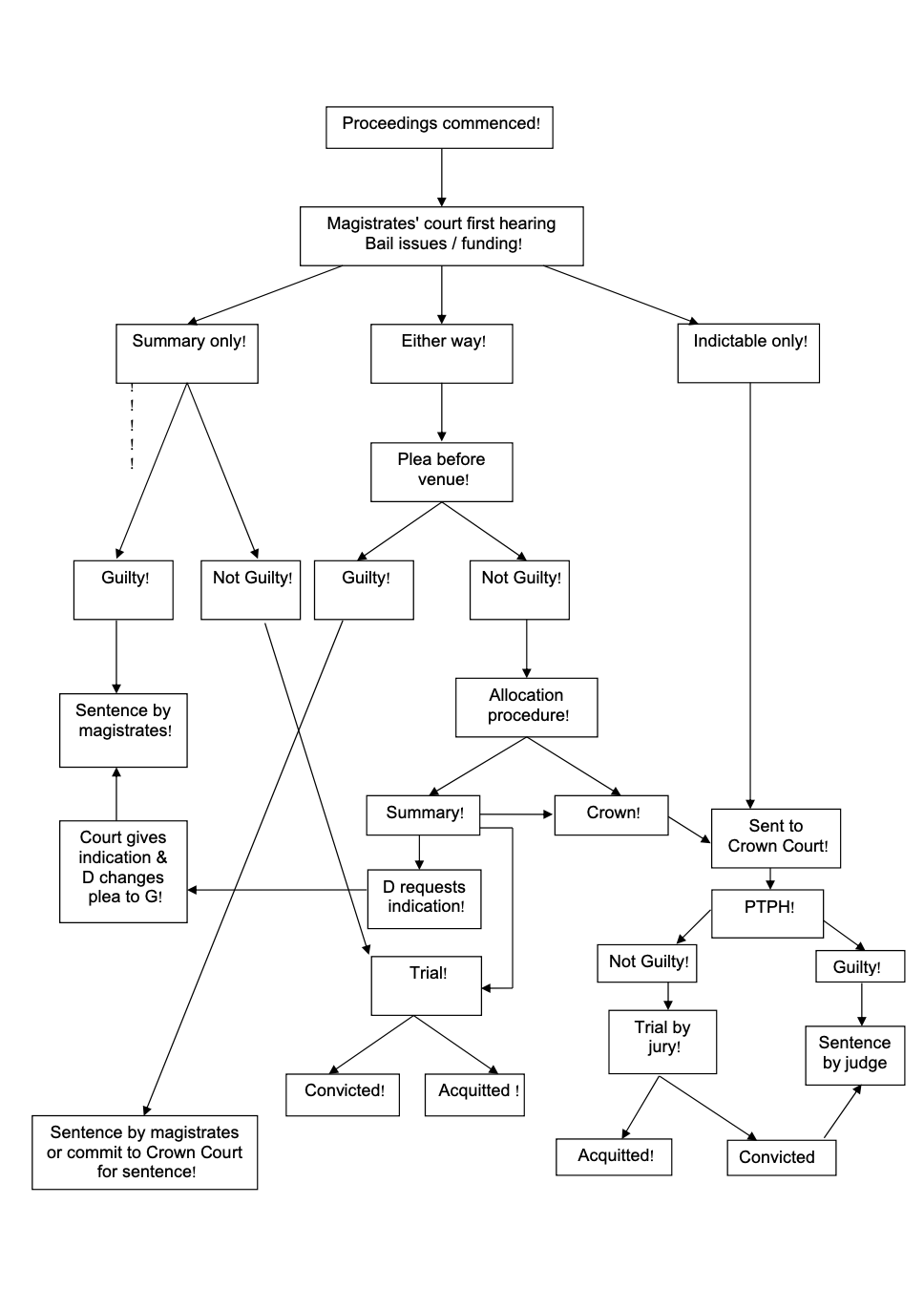
If a defendant pleads not guilty, the case proceeds to trial; a guilty plea avoids trial altogether. At trial, the prosecution must prove the offence by presenting evidence, while both sides may call witnesses. The court then determines the verdict.
A not guilty verdict results in an acquittal, meaning the defendant is free to leave. A guilty verdict — whether following trial or a guilty plea — requires the court to impose a sentence, which depends on the level of court and may include ancillary orders such as costs.
The right of appeal differs depending on how the conviction arose. A defendant who pleads guilty may challenge the sentence, while one convicted after trial may appeal against both conviction and sentence.
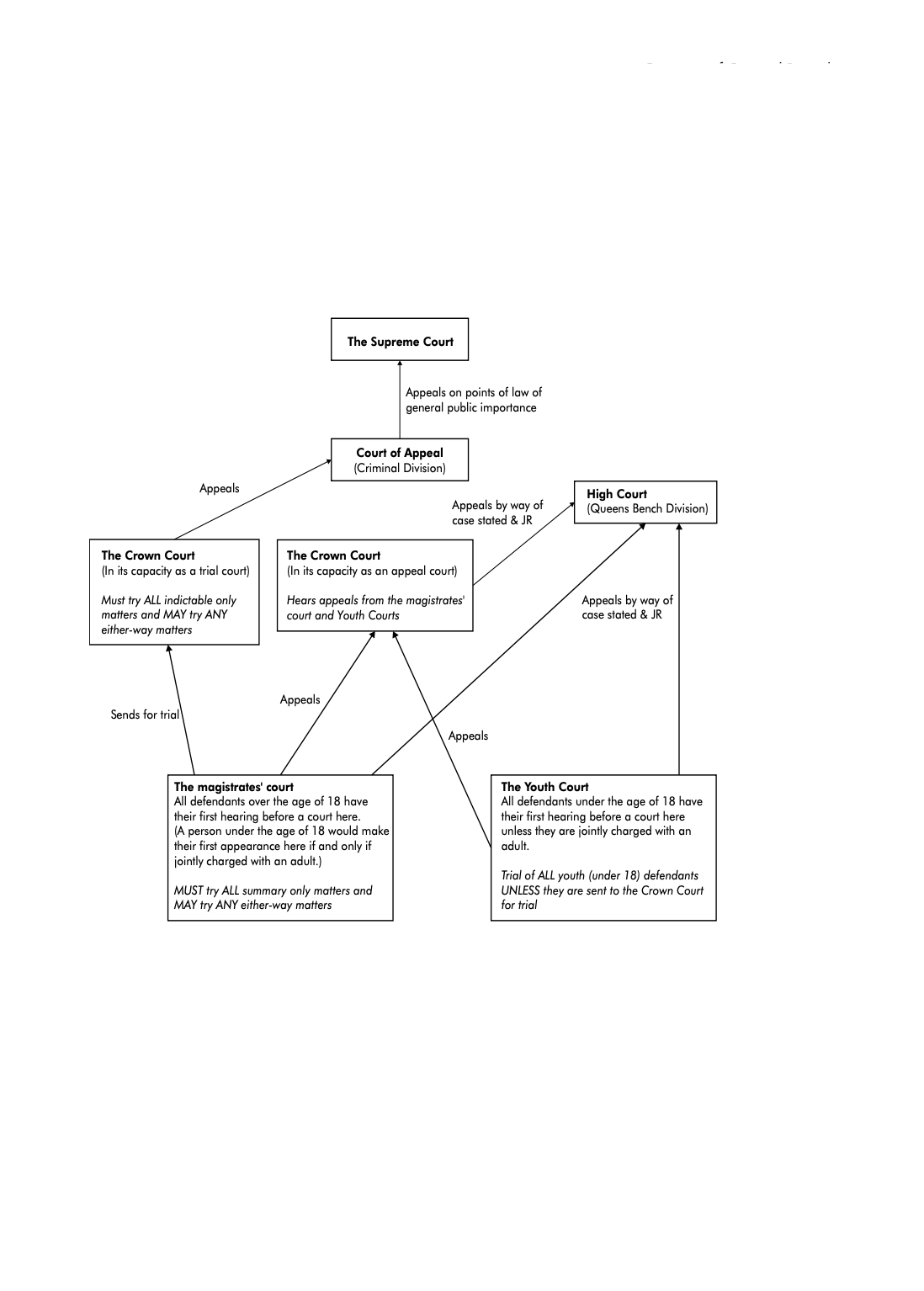
Appeals from the Magistrates’ Court or Youth Court to the Crown Court do not require permission and involve a full rehearing. Further appeals require both permission (leave) and valid grounds, from the Crown Court to the Court of Appeal and then to the Supreme Court.

At the Magistrates’ Court.
Where the journey begins.
Summary only offences are the least serious criminal offences and can only be tried and sentenced in the Magistrates’ Court.
All adults will have their first hearing at the Magistrates’ Court. This court deals with summary offences from start to finish.
What happens at court?
At the first hearing, the defendant will be asked to enter a plea to the charge.
If you plead guilty
If a guilty plea is entered, the court will usually proceed to sentence.
Sentence may be passed immediately, or
The case may be adjourned for a pre-sentence report.
If there is a dispute about the facts of the case that affects sentence, the court may hold a Newton hearing to determine the correct factual basis.
If you plead not guilty
If a not guilty plea is entered:
The court will set a trial date.
Case management directions will be given to ensure the trial is effective.
A timetable will be set, including how long the trial is expected to take.
The trial will take place in the Magistrates’ Court, as summary only offences cannot be sent to a higher court.


Either‑way offences can be tried and sentenced in either the Magistrates’ Court or the Crown Court, depending on the seriousness of the case and, in some situations, the defendant’s choice.
The defendant will first appear at the Magistrates’ Court, where they will be given details of the allegation and asked to indicate a plea.
If a guilty plea is indicated
The court will treat this as a formal guilty plea and proceed to sentence.
If there is a dispute about the facts that affect sentence, the court may hold a Newton hearing to determine the correct factual basis.
The Magistrates’ Court must then consider whether its sentencing powers are sufficient:
If sufficient: sentence may be passed immediately or adjourned for a pre‑sentence report.
If insufficient: the defendant will be committed to the Crown Court for sentence.

If a not guilty plea is indicated
The court must decide where the trial should take place.
Both the prosecution and defence may make submissions on venue. The court will consider:
The seriousness of the offence.
Any aggravating or mitigating features.
Whether its sentencing powers are adequate.
Either‑way offences are generally tried in the Magistrates’ Court unless the case is too serious.
If the Magistrates’ Court declines jurisdiction: the case will be sent to the Crown Court.
If the Magistrates’ Court accepts jurisdiction:
The defendant may agree to be tried in the Magistrates’ Court, or
Elect for trial by jury in the Crown Court.
Magistrates’ Court: trial heard by magistrates or a District Judge.
Crown Court: trial heard by a judge and jury.
If convicted in the Crown Court, sentence will be passed there.
If convicted in the Magistrates’ Court, the court may:
Sentence the defendant itself, or
Commit the case to the Crown Court if greater sentencing powers are required.

Quite often the advice will be to elect trial on indictment in the Crown Court.
This is because the acquittal rate is higher in the Crown Court, and the separate tribunals of law and fact in the Crown Court can be advantageous to the defendant.
Set against that, proceedings in a Magistrates' Court are less formal and the waiting time before the trial date is much shorter.
There is no requirement on a defendant in a Magistrates' Court to serve a defence statement. Magistrates have to give reasons for a conviction, whereas juries do not give reasons.
The sentencing powers of a Magistrates' Court are less than those of the Crown Court, but a defendant should be advised that it is not always the case that a Crown Court judge will sentence more harshly than a Magistrates' Court.
Also, a Magistrates' Court has a power to commit for sentence even after trial.
At the Crown Court.
Where the journey continues.

Indictable-only offences are the most serious criminal offences and can only be tried and sentenced in the Crown Court.
Although the case will begin in the Magistrates’ Court, this hearing is administrative only. The case will be sent to the Crown Court, as the Magistrates’ Court does not have the power to try these offences.
The defendant must attend this first hearing. If they fail to do so, the court may issue a warrant for arrest.
The prosecution must provide initial details of the case, including:
A summary of the circumstances of the offence.
Any account given in interview.
Available witness statements and exhibits.
Any victim impact statement.
The defendant’s previous convictions (if any).
These details must be provided no later than the beginning of the day of the first hearing.
A plea will be taken at the Crown Court.
A guilty plea must be unequivocal — that is, it must not suggest that the defendant is not guilty or is relying on a defence. If a plea is unclear or qualified (for example, “guilty, but I acted in self-defence”), it will be treated as a not guilty plea.
If the defendant pleads not guilty, the case will proceed to trial in the Crown Court before a judge and jury.
If convicted, sentencing will take place in the Crown Court, which has the power to impose the full range of penalties, including lengthy terms of imprisonment.
Applying for Bail.
Bail is when a defendant is released from custody until their next court hearing.
The prosecution must raise legal objections if it wants the defendant remanded in custody. Once objections are raised, the defendant may apply for bail.
All cases begin in the Magistrates’ Court, and the first decision on bail is made there. The exception is murder cases, where only a Crown Court judge may grant bail.
Bail may be refused where there are substantial grounds for believing that the defendant would:
Fail to attend court.
Commit further offences while on bail.
Interfere with witnesses or otherwise obstruct the course of justice.
When deciding whether these risks arise, the court will consider:
The nature and seriousness of the offence, and the likely sentence.
The defendant’s character, antecedents, associations, and community ties.
The defendant’s previous bail record.
The strength of the evidence.
To address these concerns, conditions may be proposed to reduce any risk.
For cases in the Magistrates’ Court:
Two applications can usually be made there.
A further application can be made to the Crown Court.
For cases going to the Crown Court:
One application is made in the Magistrates’ Court.
A further application can be made as of right in the Crown Court.

The right of Appeal.
The Crown Court
The Crown Court is predominantly a trial court (also hears appeals and committals for sentence from the Magistrates' Court).
The Court of Appeal
The Court of Appeal hears appeals from the Crown Court. Leave is required from the court for a case to be heard except in cases of contempt where appeal lies as of right.
The Supreme Court
Parties have the right to appeal decisions of the Court of Appeal to the Supreme Court. Leave is required from the Court of Appeal or Supreme Court to do so. Leave will only be granted on a point of law of general public importance.

-
Assault is making someone feel scared that they are about to be hurt. Battery is when someone actually hits or harms another person. Murder is when someone kills another person on purpose. It is very serious and carries life in prison.
-
Drug offences include possession, production, supply, and trafficking. The most dangerous drugs include heroin, cocaine, and ecstasy. Cannabis is also illegal.
-
These are illegal acts involving guns. This includes holding a firearm, firing a gun, or using one to commit a crime. It also includes possession of prohibited weapons such as handguns or automatic firearms. Possession with intent to endanger life may carry a life sentence.
-
These include rape and sexual assault. The law looks at consent, whether there was a genuine belief in consent, and whether that belief was reasonable. Each case depends on its own facts.
-
Theft involves dishonesty, including taking property or keeping lost property without trying to return it. It is a breach of trust. Robbery is theft involving force or threats and cannot exist without theft. Burglary is entering a building to commit a crime and is more than simple theft. You do not have to be the thief — helping to keep stolen property is also an offence.
-
Money laundering is dealing with ill‑gotten gains or undeclared earnings. These are called proceeds of crime — money or assets that come from criminal activity. The law allows authorities to confiscate the profits of crime. Banks, lawyers and accountants must report suspicious activity. Stolen items, or money and assets linked to drug dealing or fraud, can also lead to money laundering charges. Crime does not pay.